






Red Shishito Chile Peppers
Inventory, lb : 0
Description/Taste
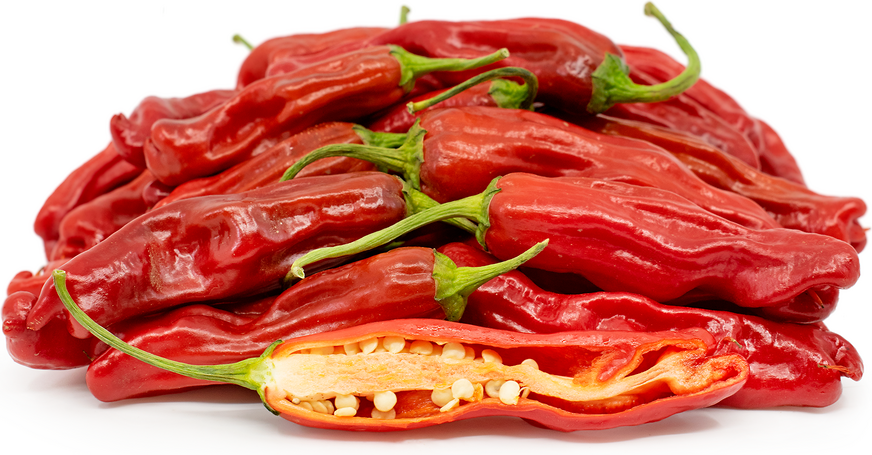
Red Shishito chile peppers are slender, slightly curved pods, averaging 7 to 10 centimeters in length, and have a cylindrical shape with an inward folded tip on the non-stem end. The skin is glossy and smooth, ripening from green to dark red when mature, and is covered in deep folds, wrinkles, and creases. Underneath the delicate skin, the flesh is thin, crisp, aqueous, and pale red, encasing a central cavity filled with membranes and small, round, and flat, cream-colored seeds. Red Shishito chile peppers have a sweet, piquant, and peppery flavor. The peppers also contain a mild heat with the occasional pod having hotter attributes, and when cooked, they develop savory, smoky nuances.
Seasons/Availability
Red Shishito chile peppers are available year-round with a peak season in summer through early fall.
Current Facts
Red Shishito chile peppers, botanically classified as Capsicum annuum, are a relatively mild, Japanese variety that belongs to the Solanaceae or nightshade family. The dark red pods are the mature versions of the pepper left on the plant to fully develop flavor, color, and spice. Red Shishito chile peppers are classified as a sweet Japanese pepper variety, averaging 100-1,000 SHU on the Scoville scale, but that does not guarantee that all Red Shishito peppers will be mild. Approximately one in ten peppers will contain a spicy kick, and there is no definitive way to distinguish spicy pods from mild ones except for tasting the pepper. Also known as Lion chile peppers, Red Shishito chile peppers earn their name from the Japanese word for lion, shishi, and it is believed that the creased tip resembles the head of a lion. The peppers are also known as Kkwarigochu in Korea and are a well-liked snack commonly packed in school lunch boxes. Red Shishito chile peppers are more challenging to find in commercial markets in comparison to their green counterparts and are frequently reserved for local farmer’s markets. Regardless of maturity, Red Shishito chile peppers can be used interchangeably with green shishito peppers in recipes and are a popular snack food item in Japan. In recent years, the peppers have also become a common variety in the United States, favored for their thin skins and bright, sweet flavors, and are appearing on menus at restaurants in a wide range of applications.
Nutritional Value
Red Shishito chile peppers are an excellent source of fiber, which can help stimulate digestion and vitamins B6, C, and K, which can help protect and boost the immune system. The peppers are also a good source of potassium, vitamin A, and folate.
Applications
Red Shishito chile peppers are best suited for lightly cooked applications such as roasting, blistering, grilling, and sautéing as the peppers have a thin skin that cooks quickly. Red Shishito chile peppers are popularly blistered in oil over an open fire, sprinkled with salt, and served whole as a finger-food appetizer or side dish. The blistered peppers are also commonly served with a variety of sauces such as shoyu, garlic aioli, sesame ginger, lemon tahini, soy sauce, and dashi stock, and are topped with bonito flakes, sriracha salt, or furikake, which is a Japanese spice blend. In addition to cooking the peppers and serving them as a stand-alone dish, the peppers can be blistered or charred and added to sandwiches, burgers, tacos, soups, stews, curries, and eggs. They can also be chopped into salsas, stuffed with cheeses, quick-pickled, mixed into pasta, or sliced into Asian noodle dishes. Red Shishito chile peppers pair well with goat cheese, tomatoes, hot peppers, leeks, carrots, daikon, cilantro, mint, lemons, capers, and meats such as fish, pork, poultry, and beef. The fresh peppers will keep 1-2 weeks when stored whole and unwashed in a paper or plastic bag in the refrigerator.
Ethnic/Cultural Info
Shishito chile peppers are a popular summertime appetizer that is often served as finger food in Japan and are favored for their thin skin and light flavor. In traditional Japanese cuisine, lighter flavored foods are served first, and the heavier, stronger flavored dishes are served towards the end of the meal to preserve the palate. With globalization and the rise of Japanese restaurants around the world, Shishito chile peppers have also become a favored ingredient at small plate restaurants internationally. Despite their simple culinary origins, Shishito chile peppers are currently being used by chefs in the United States as a base ingredient in many fusion dishes. Combining the peppers with Peruvian sauces, charring and smashing into sandwiches, or mixing into tomato-based pasta dishes, Shishito chile peppers are a trending pepper of the 21st century that is allowing chefs to create modern and innovative dishes using established ingredients.
Geography/History
Red Shishito chile peppers are native to Japan and are believed to have been developed from padron chile peppers, which were a highly sought-after variety in Spain. First introduced to Japan through Portuguese explorers in the 16th century, peppers became highly cultivated across Japan and were selectively bred for specific flavor characteristics. Today Red Shishito chile peppers are grown on a small scale in Japan and are also grown in Europe and the United States. The peppers can be found through local farmer’s markets, at specialty grocers, and are also sold through online seed catalogs for home garden use.
Recipe Ideas
Recipes that include Red Shishito Chile Peppers. One
 is easiest, three is harder.