







Northern Spy Apples
Inventory, lb : 0
This item was last sold on : 11/18/23
Description/Taste
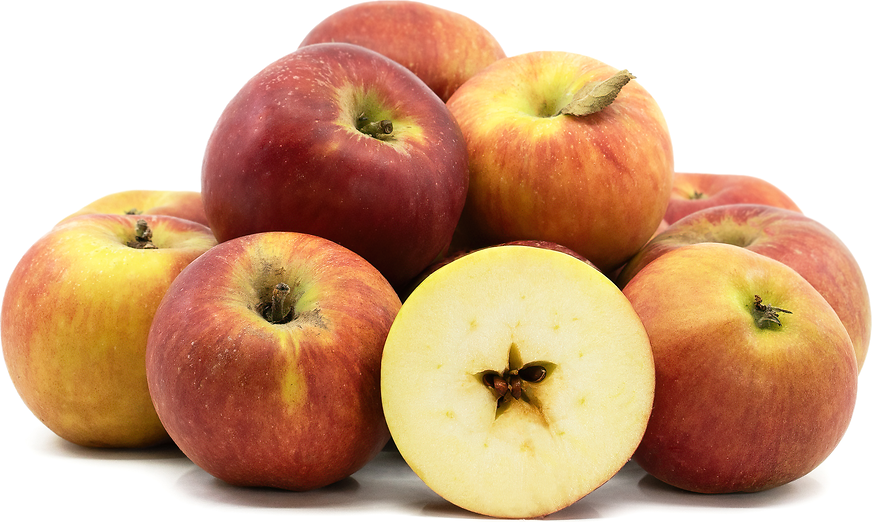
Northern Spy apples are a medium to large varietal and have a somewhat irregular, round, conical, to oblate shape with a flattened, slanted base and curved shoulders. The apple's surface is ribbed, showcases dark brown, textured russeting in the stem cavity, and has a few prominent lenticels. The skin is thin, easily bruised and damaged, and has a smooth, taut, and semi-glossy nature, often covered in a dull, delicate bloom. The skin also showcases a yellow-green coloring, covered in streaking and patches of pale red to yellow hues. Underneath the surface, the yellow flesh is firm, dense, aqueous, and moderately fine-grained, with a crisp but tender consistency. The flesh also encases a small central core filled with tiny black-brown seeds. Northern Spy apples release an aromatic scent reminiscent of sweet cider. The apples have high sugar mixed with acidity, creating a sweet-tart, sprightly taste with an intense rush of initial tartness followed by a honeyed, fruity sweetness with nuances of pears, warm spices, and cherries.
Seasons/Availability
Northern Spy apples are harvested in the late fall and are available through the spring.
Current Facts
Northern Spy apples, botanically classified as Malus domestica, are an heirloom American variety belonging to the Rosaceae family. The late-season fruits grow on trees reaching 3 to 4.8 meters in height and are an all-purpose variety utilized for fresh recipes, cooked preparations, and cider processing. Northern Spy apples were developed in the early 19th century in New York and quickly became a favored variety for home gardens as the trees were easy-to-grow, vigorous, and somewhat hardy. The apples were also cold tolerant, surviving for extended periods, providing a fresh food source during the bleak northeastern winters. Throughout history, Northern Spy apples have become a symbol of Americana. In 1953, the Toronto Globe and Mail sent Northern Spy apples to Senator Joseph McCarthy as a joke during McCarthy's hunt for communist spies. Allegations were being made of spies in Canada, so the Canadian news outlet sent the spy apples to McCarty, which was met with McCarthy holding the apples and laughing, captured in a famous photo. "Spies for pies!" was another well-known slogan throughout the American baking scene in the 19th and early 20th centuries, with many bakers refusing to use any other variety for their homemade creations. Northern Spy apples remained a treasured American fruit into the 21st century, even after they departed from the commercial spotlight. In 2013, the variety was one of four apples honored by the United States Postal Service and was placed on commemorative stamps designed by artist John Burgoyne. In the modern day, Northern Spy Apples are valued for their crisp texture and sharp flavor and are most famous for their use in pies and ciders.
Nutritional Value
Northern Spy apples have not been extensively studied for their nutritional properties. Like other bi-colored varieties, the apples are a source of vitamin C to strengthen the immune system and fiber to regulate the digestive tract. The apples also provide potassium to balance fluid levels within the body, vitamin K to assist in faster wound healing, calcium to build strong bones and teeth, vitamin A to maintain healthy organ functioning, and other nutrients, including vitamin E, magnesium, manganese, zinc, copper, and phosphorus. The vibrant red hues within the skin indicate the presence of anthocyanins, pigmented compounds with antioxidant-like properties to protect the cells against the damage and oxidative stress caused by free radicals.
Applications
Northern Spy apples have a sweet-tart taste suited for fresh and cooked preparations. The apples can be consumed straight out of hand, and their thin skin and crisp, tender flesh create a favorable eating experience. Northern Spy apples can also be shredded into slaws, tossed into salads, mixed into fruit bowls, or chopped as a fresh garnish over breakfast dishes. In the eastern United States, Northern Spy apples are often served on appetizer plates alongside cheeses, honey, and nuts. The variety can also be blended into smoothies and juices and is popularly added to ciders for flavor. It is said Northern Spy apples contribute a clean, crisp taste with mineral qualities when fermented. In addition to fresh preparations, Northern Spy apples can be cooked and pureed into apple sauce, roasted with root vegetables as a savory-sweet side dish, or sauteed with browned butter and spices as a decadent topping. Northern Spy apples can also be baked into cakes, muffins, cobblers, bread, and pies. The variety is famously used for apple pie, so much so that it is sometimes known as Northern Pie apples, and historical slogans about the pie include "if it wasn't made with Spy, it's not worth eating." Northern Spy apples pair well with vanilla, maple syrup, spices such as cinnamon, cloves, ginger, and nutmeg, herbs including mint, basil, and rosemary, and fruits such as oranges, berries, and bananas. Whole, unwashed Norther Spy apples will keep for several weeks when stored in a cool, dry, and dark place such as a cellar or in the refrigerator's crisper drawer. In professional cold storage, the variety can keep for 3 to 6 months.
Ethnic/Cultural Info
There are several legends behind the apple's name, but in true espionage fashion, the answer is thought to have self-destructed with its creators and remains shrouded in mystery. The first theory points to the Chapin family's history as soldiers. The Chapin family's founder Deacon Samuel Chapin was one of the early settlers of the Massachusetts Bay Colony in the early 1630s. His bloodline continued throughout American history, including connections to President Grover Cleveland and William H. Taft, abolitionist Henry Ward Beecher, and Poet T.S. Eliot. The Chapin family also had several famous soldiers and war leaders, including General Israel Chapin. It is thought the name Northern Spy apples was taken from an 1821 book written by James Fennimore Cooper entitled The Spy: A Tale of the Neutral Ground. The novel's plot involves a man spying on the British during the Revolutionary War. Legend has it the book was inspired by John Jay, a revolutionary who helped form the U.S. counterintelligence. John Jay was a friend and colleague of General Israel Chapin, thus tying together the theory that Northern Spy may have been derived from the Chapin family's involvement and close relations to various members of secret intelligence. The other leading theory connects the apple's name to a written piece that was circulated among abolitionists in the 1830s. This piece told the story of a "Northern Spy" who established safehouses to transport slaves from Virginia to New York. The spy would impersonate a slave catcher and would usher slaves to safety, killing leaders in the pro-slavery movement. Much of the history of this written piece is unknown, but it was said to have later inspired the book written by J. Thomas Warren called The Northern Spy: The Fatal Papers.
Geography/History
Northern Spy apples are native to the United States and were discovered in the 19th century. The trees that produced the first Northern Spy apples were initially grown on a farm in Salisbury, Connecticut, by a man named Elijah Taylor. Taylor later carried the seedlings to New York, where he sold one to Heman Chapin in East Bloomfield, a town in Ontario County. Chapin planted the seedling around 1800, and it is thought that one of the apple's parent varieties may be the Wagner apple. Despite Chapin's efforts to nurture the slow-growing apple tree, the tree was eventually killed by rabbits or mice before it had a chance to bloom. Seedlings later appeared among the tree's roots, and Chapin's brother-in-law Roswell Humphrey replanted the seedlings on his connected property. Humphrey's tree bloomed in 1825, and by 1830, the tree was producing apples. Humphrey sold the new apple variety locally for several years, but in 1840, the cultivar was officially recorded under the name Northern Spy in an issue of The Cultivator in 1842. In the article, author J.J. Thomas of Macedon listed the variety as an apple recommended for small gardens. Northern Spy apples were featured in other publications and began appearing in nurseries throughout the northeastern United States, increasing in popularity among growers. In 1852, the American Pomological Society listed Northern Apples as a variety worth cultivating, and for many years after its release, it was one of the most popular northern apple cultivars in the United States. Over time, Northern Spy apples faded from commercial production as the apples fell out of favor for their irregular shape and coloring, easily bruised skin, and low disease resistance. The fruits were replaced with modern apple varieties, leading Northern Spy apples to become a rare specialty apple primarily grown in home gardens. Today Northern Spy apples are produced on a small scale, mainly in the northeastern United States, and are an heirloom variety sold directly through growers, at local farmer's markets, and through select distributors. The variety is also used in processing ciders.
Recipe Ideas
Recipes that include Northern Spy Apples. One
 is easiest, three is harder.