








Collard Greens
Inventory, 24 ct : 4.92
This item was last sold on : 04/28/24
Description/Taste
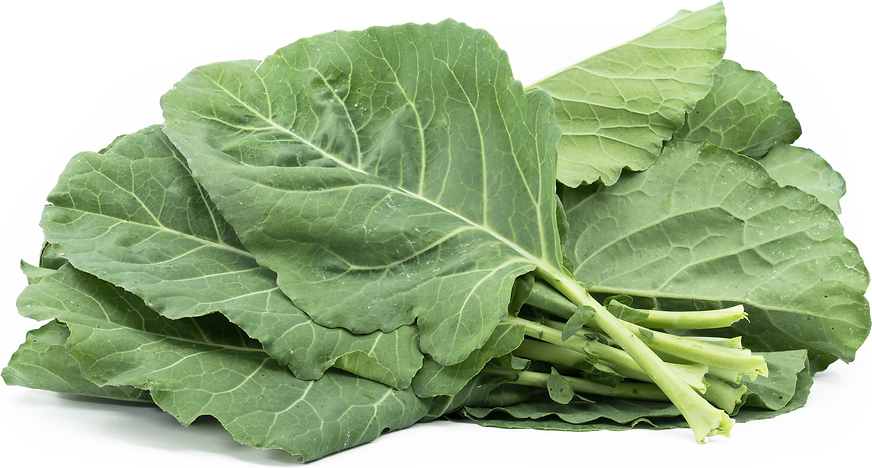
Collard greens are a headless forming cabbage, similar to kale. Their leaves are broad, paddle-shaped and grey green to deep green in color with contrasting succulent white ribs and veins. Their flavor is assertive, almost alkaline and true to its family, cruciferous in nature. Collard greens should be chewy in texture, a sign of good water content and freshness. Late winter and early spring provide the sweetest and most tender Collard greens.
Seasons/Availability
Collard greens are available year-round with peak season in late winter.
Current Facts
Collard greens are members of the economically important Brassicaceae family, known for its cruciferous vegetables such as cabbage, broccoli and kale. Collard greens contain a chemical compound called phenylthiocarbamide, known more simply as PTC. This compound is responsible for the bitterness that people taste when they eat Collard greens. Specific human genes determine whether a person can taste this bitterness. Not all humans can taste the compound's bitter tendencies, though it is a dominant trait in about 70% of the human population. Those who do taste the bitterness either enjoy bitter foods or absolutely dislike it.
Nutritional Value
Collard greens are loaded with health benefiting vitamins and compounds. They contain anti-inflammatory properties in the form of Omega-3 fatty acids and Vitamin K. They also contain the antioxidants beta carotene, Vitamins C and E and detoxifying glucosinolates, compounds that are being studied for their abilities to prevent cancer as well as cardiovascular disease.
Applications
Collard greens are synonymous with slow cooking and simmering in a pot with ham hocks. The broth created after about 90 minutes of simmering is known as pot liquor and it is equal parts vitamin rich, smoky and delicious. This ages old application is a benchmark for cooking Collard greens but there are many other ways to enjoy the greens. A quick braise or blanch allows for full nutritional retention and maximum flavor. They can also be added to baked dishes as well. Though many may say the bitterness is off-putting when eaten raw, Collard greens can add flavor and texture to salad mixes. Complimentary ingredients include garlic, pork, chicken, grilled steak,, mushrooms, potatoes, apple cider vinegar, lemon, bay leaves, bacon fat, soy sauce, ginger, sesame oil, tomatoes and chiles.
Ethnic/Cultural Info
Although most Americans associate Collard greens with Southern Soul Food Cooking and its historical and cultural slave trade roots, they are also historically linked to to Asian cooking as well as Greek and Roman cooking. Collard greens are most popular in the Kashmir state of India, where they are literally a household staple of the entire population and eaten for their leaves and roots.
Geography/History
Collard greens are an ancient green native to Asia Minor with cultivation dating back to circa 5000 BC. From Asia Minor via trade routes, Collard greens expanded to Africa and Europe and eventually the Americas. By 1600 Collard greens had become globally cultivated. Today their distribution is vast and wide, making them a highly valued yet low cost global culinary commodity. Collard greens can be found in almost any market throughout all hemispheres.
Featured Restaurants
Restaurants currently purchasing this product as an ingredient for their menu.
| Artifact at Mingei | San Diego CA | 619-846-2164 |
| Louisiana Purchase | San Diego CA | 619-255-8278 |
| UCSD Food & Nutrition Department La Jolla | San Diego CA | 858-761-1269 |
| Tartine | Coronado CA | 619-435-4323 |
| Sabor Piri Piri | San Diego CA | 619-694-0704 |
| La Costa Glen South | Carlsbad CA | 760-704-1000 |
| Trust Restaurant | San Diego CA | 609-780-7572 |
| Rancho Bernardo Inn | San Diego CA | 877-517-9340 |
| Smokin J's BBQ | San Diego CA | 703-314-1486 |
| UCSD Food & Nutrition Department Hillcrest | San Diego CA | 619-380-9840 |
| Ridgeview Health Center | San Diego CA | 858-293-3950 |
| San Diego Humane Society | San Diego CA | 619-299-7012 |
| Encontro North Park | San Diego CA | 310-955-6333 |
| Flying Pig Pub & Kitchen | Oceanside CA | 619-990-0158 |
| The Glen at Scripps Ranch | San Diego CA | 858-444-8500 |
| Peace Pies (Encinitas) | Encinitas CA | 619-618-6960 |
| Rancho Santa Fe Golf Club | Rancho Santa Fe CA | 858-756-1582 |
Recipe Ideas
Recipes that include Collard Greens. One
 is easiest, three is harder.