








Babaco
Inventory, lb : 0
Description/Taste
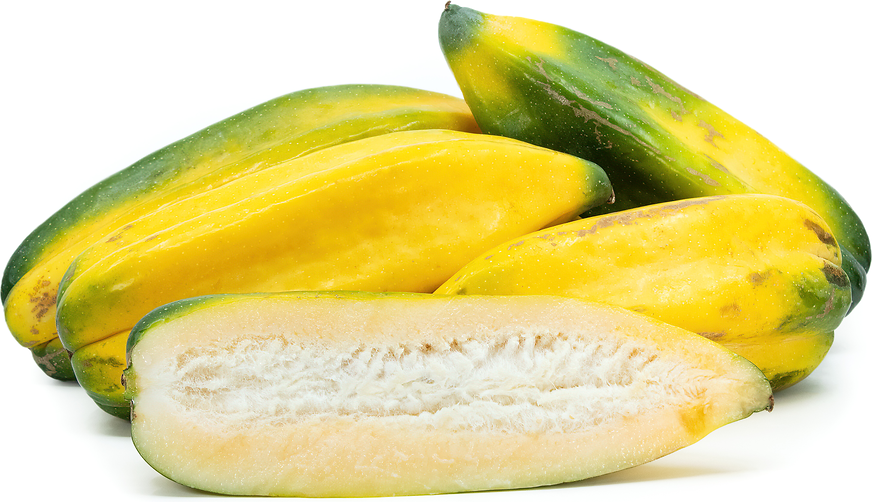
Babaco is a torpedo-shaped fruit, similar in size to an acorn squash, that can reach lengths up to thirty centimeters and ten centimeters in diameter. It has a distinct pentagonal shape that, when cut crosswise, creates a star pattern. The fruit's skin is smooth and thin with faint white dots. As Babaco matures, it transitions from green to vibrant yellow, indicating that it has reached peak ripeness. The interior of the seedless fruit transitions from a bright yellow, mango-like texture to a cotton-white, succulent consistency. Babaco exudes sweet aromatics reminiscent of pineapple, papaya, strawberry, and kiwi. Its flavor is a complex layering of tropical and subtly acidic notes, echoing the essences of pineapple and kiwi, as well as its ancestral fruit, papaya.
Seasons/Availability
Babaco is harvested from October to December.
Current Facts
Babaco, botanically classified as Carica pentagona, is a tropical fruit belonging to the Caricaceae family. The species is also known throughout the Americas as Mountain Papaya, Chamburo, and Champagne fruit, and each plant can produce 30 to 60 fruits each season. Babaco grows on branching trees reaching 5 to 8 meters in height and is cultivated for both domestic consumption and commercial purposes. The fruits are frequently available in fresh markets or processed into various juices and canned products. Despite its ease of storage and high-yielding nature, Babaco remains relatively obscure outside its primary cultivation areas in Ecuador and New Zealand.
Nutritional Value
Babaco fruit is rich in vitamins C, A, thiamine, riboflavin, and niacin, bolstering immune health. Its high fiber content aids digestion, prevents constipation, and contributes to satiety, potentially supporting weight loss efforts. Pectin, a type of soluble fiber in Babaco, may help reduce cholesterol levels. Additionally, its antioxidants diminish inflammation, while a high potassium content lowers blood pressure. Babaco is a low-glycemic food that helps maintain steady blood sugar levels and prevent insulin spikes. It also contains significant amounts of papain, a digestive enzyme that breaks down protein, which, like its parent fruit, papaya, is used in digestive supplements. The white milky juice from Babaco can be used as a treatment for warts.
Applications
Babaco can be consumed entirely, with or without the skin, either raw or cooked. In its raw state, Babaco is commonly sliced and savored on its own or pureed into smoothies and fruit drinks. It can be used as a topping for cakes, tarts, and ice cream, or as an addition to salads and salsas. When cooked, Babaco can be combined with sugar to create jam, chutney, or syrup. It can also be used in pastries and pies or grilled with a caramelized topping. In Ecuador, Babaco is simmered with sugar and spices like cinnamon to create dulce de Babaco, a popular dessert typically enjoyed with ice cream or whipped cream. Babaco can also be used as a dual-purpose natural meat tenderizer and marinade. Babaco pairs well with other tropical fruits such as pineapple, strawberries, peaches, coconut, and mangoes, chiles, ginger, avocados, poultry, prosciutto, and ham. Citruses such as lime and grapefruit also enhance the fruit's flavor. Ripe, uncut Babaco has a shelf life of up to four weeks. Once opened, the fruit can be wrapped and stored in the fridge for 2 to 3 days.
Ethnic/Cultural Info
In Ecuador, Babaco plays a role in the Corpus Christi festivals, which are celebrated in June to bring together Catholic traditions and indigenous customs. The name Corpus Christi translates to “The Body of Christ” and is an annual celebration held across towns with community gatherings, religious services, parades, and live entertainment. In the Province of Luya, Peru, Babaco liqueur is created by macerating the fruit's pulp and seeds in aguardiente, an alcoholic spirit well-known in Latin America and Spain. This spirit is often used for toasting during celebrations, including Corpus Christi festivals, and as a digestive after meals.
Geography/History
Babaco fruit was originally discovered in the Andean Highlands of Ecuador. It grows best in humid, subtropical climates and does not tolerate strong winds or hot, dry conditions. Babaco fruit grows in clusters on evergreen shrubs or trees that resemble small palm trees and is typically cultivated at higher altitudes, ranging from approximately 1,500 to 2,500 meters. Babaco is thought to be a natural hybrid of two Andean fruits: the Mountain Papaya and the Inga. This likely occurred when these plants grew close to each other in the wild. The fruit was introduced to New Zealand in the early 1970s and later to Europe in 1985, notably in Italy and Spain. It has also been distributed and naturalized in tropical and subtropical regions of Central America. Babaco production thrives in New Zealand's mountainous areas, where conditions closely resemble those of the Ecuadorian Highlands. Babaco fruit is not widely dispersed commercially and is primarily found in regions with climates similar to its native Andean habitat. Common places to find Babaco include Colombia, Peru, Bolivia, Venezuela, and California. In these locations, Babaco would be found at a local farmers' market or specialty stores.
Recipe Ideas
Recipes that include Babaco. One
 is easiest, three is harder.
| Laylita's Recipes |
|
Ecuadorian Fruit and Oatmeal Drink |
| Just Recipes |
|
Babaco Chutney |