








Hachiya Persimmons
Inventory, ea : 0
Description/Taste
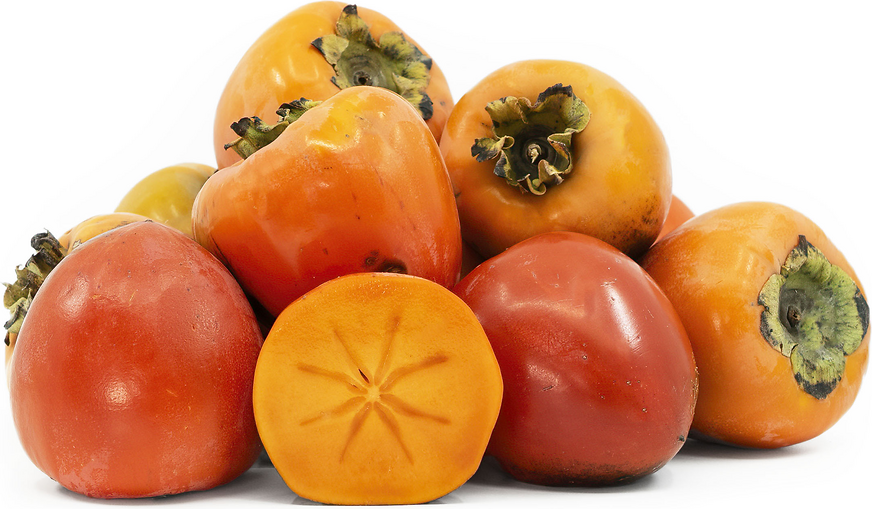
Hachiya persimmons are medium to large fruits, averaging 7 to 10 centimeters in diameter, and have an oval and elongated shape. The fruits have distinct, curved, and broad shoulders, tapering to a small point on the non-stem end, and are similar in appearance to an acorn. The skin is glossy, smooth, taut, and thin when young, occasionally bearing black sunspots, and the surface ripens to a yellow-orange, orange, or red-orange hue when mature. The skin will also become more translucent and will wrinkle as the fruit ripens. Underneath the surface, the flesh is dense, firm, and golden orange when unripe with a high tannin content, creating an unpalatable, astringent flavor. As the fruit matures, the tannins break down in the flesh, producing a gelatinous, aqueous, and soft texture with increased sweetness. Ripe Hachiya persimmons have a very soft, delicate, and squishy feel, similar in consistency to a water balloon when squeezed. The ripe fruits also contain a sweet, honeyed flavor with subtle nuances of brown sugar, cinnamon, mango, and apricot.
Seasons/Availability
Hachiya persimmons are available in the late fall through winter.
Current Facts
Hachiya persimmons, botanically classified as Diospyros kaki, are ancient fruits that grow on deciduous trees reaching up to 18 meters in height, belonging to the Ebenaceae family. There are two main categories of persimmons, astringent and non-astringent, and Hachiya persimmons are a type of astringent persimmon, meaning the flesh is deemed inedible until fully ripe. As the fruits mature, the flesh will soften, and the tannins will reduce, creating a jelly-like, juicy consistency with a sweet, honeyed flavor. Hachiya persimmons are native to East Asia and have been extensively cultivated for thousands of years, utilized in fresh and dried culinary applications. The fruits are prevalent throughout Asian markets, and beyond culinary preparations, Hachiya persimmons have also been traditionally used for ornamental and medicinal purposes. Outside of Asia, Hachiya persimmons are somewhat rare, but the astringent fruits have become one of the most popular persimmons grown in California as a seasonal item.
Nutritional Value
Hachiya persimmons are an excellent source of vitamin C, an antioxidant that boosts the immune system and reduces inflammation. The fruits are also a good source of fiber to regulate the digestive tract, provide some calcium to strengthen bones, and contain lower amounts of iron and vitamin A.
Applications
Hachiya persimmons should be fully ripened before consumption, and the ripening process ranges from a few days to a few weeks, depending on the firmness of the flesh. Hachiya persimmons can be left to ripen on the counter at room temperature, and once soft and gelatinous, the flesh can be eaten fresh, spooned over oatmeal, yogurt, pancakes, and ice cream, or blended into sauces. The ripe fruits are also popularly used in custards and puddings or incorporated into baked goods such as bread, cakes, pies, and muffins. In Japan, Hachiya persimmons are simmered into jams, compotes, and preserves, and whole fruits are frozen and eaten as a natural sorbet. The fruits are also traditionally dried and eaten as a chewy snack or used as a sweetener in desserts, purees, and sauces. Hachiya persimmons pair well with spices such as nutmeg, cinnamon, allspice, and ginger, maple syrup, vanilla, honey, nuts such as almonds, walnuts, and pistachios, and fruits such as pomegranates, oranges, apples, and pears. Once ripe, Hachiya persimmons should be immediately consumed for the best quality and flavor. The fruits can also be stored in the refrigerator for an additional 1 to 2 days.
Ethnic/Cultural Info
In Japan, Hachiya persimmons are revered for their drying ability and are traditionally made into hoshigaki. The name hoshigaki is a combination of “hoshi,” meaning “dry” and “kaki,” meaning “persimmon,” and hoshigaki has been made for centuries as a method to preserve fruits during the cold winter months. The traditional drying process uses unripe Hachiya persimmons, and the fruits are peeled, hung from a string, and left to dry for 4 to 6 weeks. As the fruits are drying, they must be hand massaged to soften the flesh, and over time, they develop a soft, dense, sticky, and chewy consistency. Hoshigaki also produce a white bloom on the surface, which is a natural coating of sugar, and this bloom is one of the traits that signals the dried fruits are ready for consumption. Hoshigaki are commonly sliced and consumed as a sweet snack, or they are used to flavor wagashi, Japanese sweets served with green tea. The dried fruits are also used as decorations during New Year celebrations. Hoshigaki can be seen strung in windows, along covered porches, and in well-ventilated rooms, and the fruits are a symbol of longevity and good luck. Some Japanese families also gift hoshigaki to friends and family as a gesture of goodwill.
Geography/History
Hachiya persimmons are native to China, where they have been cultivated for centuries. The astringent fruits eventually spread to Korea and Japan sometime before the 7th century and were extensively cultivated by the 10th century. Hachiya persimmons were also introduced to the United States through the USDA in 1870 and were planted in California, Georgia, and Florida. Today Hachiya persimmons are widely grown throughout East Asia in Japan, China, Korea, and Vietnam and are primarily found through fresh markets and local grocers. The fruits are also cultivated in California and are sold through farmer’s markets and specialty grocers as a limited release.
Recipe Ideas
Recipes that include Hachiya Persimmons. One
 is easiest, three is harder.
| The Global Girl |
|
Raw Vegan Persimmon & Carob Tart |
| Taste and See |
|
Persimmons Wrapped in Prosciutto |
| The Colors of India Cooking |
|
Dairy Free Persimmon Ice Cream |
| Tasty Kitchen |
|
Spiced Persimmon Muffins |