



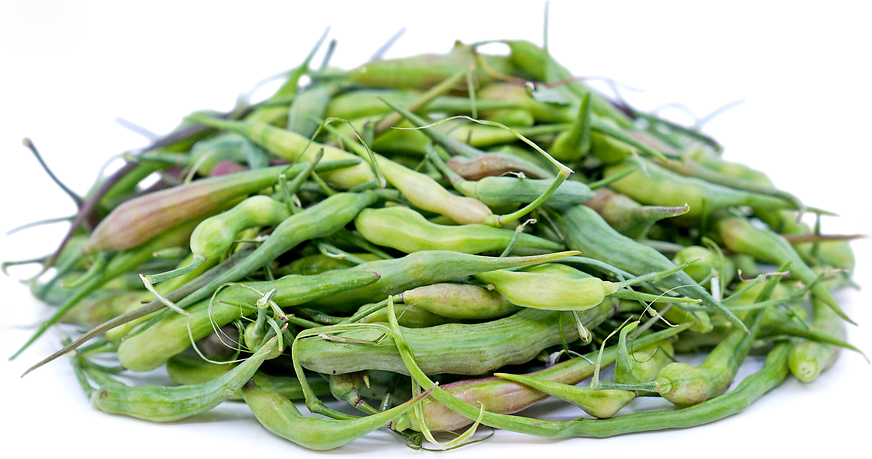


Radish Pods
Estimated Inventory, lb : 0
Grower
Radish pods are the seed pods that develop from radish plants when they are allowed to bloom instead of being harvested for their roots. They grow in taper-ended, bean-like pods that carry one to two seeds and resemble edamame or green beans. Their color ranges from green to purple and if left to mature, will become dry and brittle. Radish pods have a fresh and slightly peppery scent. They have a crisp and succulent texture, with the same peppery notes as radish roots. Their peppery flavor is due to glucosinolates, which are organic compounds that occur in nearly all of the Brassica family.
Radish pods are available after the roots have matured and the flowers have died away, typically in the summer.
Radishes are scientifically classified as Raphanus sativus and are members of the Brassica, or mustard, family along with bok choy, arugula, broccoli, kale, cauliflower, rutabaga, and turnips. The long, narrow pods of radishes are called siliques, which is a common feature that many plants within the mustard family possess. Radishes left to mature and bloom into a flower instead of being harvested for their roots will produce edible seed pods. Some radish varieties, like the Rattail radish, do not produce an edible root and are grown specifically for their pods. Other radish varieties can be left past their regular harvesting season and will produce edible seed pods within a month. In India, Radish pods go by the names Moongra, Mogri, and Singri.
Radish pods are a source of ascorbic acid, which is important for the development of body tissues, wound healing, immune system function, iron absorption, collagen production, and bone and teeth health. They contain folic acid and potassium, which may help prevent birth defects in pregnant women, regulate fluid balance, muscle contractions, and nerve signals, and reduce blood pressure, potentially decreasing the risk of stroke, osteoporosis, and kidney stones. Radish pods are a good source of vitamins B6 and B2, which can aid in brain development, mood and cognitive function, vision, skin health, and converting carbohydrates, fats, and protein into energy. Radish pods contain copper, magnesium, and calcium, which are important for maintaining healthy bones and blood vessels, preventing anemia, controlling blood glucose levels, maintaining normal blood pressure, and promoting cardiovascular health.
Radish pods can be eaten fresh, fried, baked, pickled, or sautéed. In their raw form, they can be enjoyed by snipping off the end and using them for crudité platters, green salads, wraps, pita sandwiches, tacos, noodle dishes, or as a garnish for savory cocktails. They can be used in soups, omelets, stir-fries, pasta, or rice bowls. Radish pods are used in Indian cuisine, where they are combined with ingredients like dried mango powder, amchur, potatoes, turmeric, red chili powder, and garam masala. Radish pods can be battered and fried to make tempura or pickled with vinegar, salt, sugar, and spices. Foods that complement radish pods include apples, anise, basil, bacon, broccoli, Brussels sprouts, butter, cabbage, carrots, cauliflower, celery, cheese, chiles, collard greens, cinnamon, coriander, cucumbers, fennel, fresh greens, ginger, kale, lemon balm, lime, mint, mushrooms, parsley, roasted meats, salmon, tomatoes, turnips, and wasabi. Radish pods should be washed, dried, wrapped in plastic, and stored in the refrigerator crisper, where they will last up to a week.
Radishes are intertwined with cultures throughout history. Ancient Egyptian writings indicate that radishes were cultivated before the construction of the pyramids. In ancient Greece, small golden radish replicas were offered to the god Apollo. By the late 1500s, radishes had become popular in England and were one of the first crops introduced to the New World by the Spaniards. During the Middle Ages, people began cultivating giant radishes and by the 16th century, a radish weighing 100 pounds was found in Germany. Radishes were being planted in Mexico and Haiti by the 16th century and by the mid-1800s, there were 8 different varieties of radishes in the Americas. One of the first recorded uses of Radish pods is mentioned in Acetaria: A Discourse of Sallets, a book written in 1699 by John Evelyn about the value of making salads and cultivating native herbs and fruit. In 1789, The London Art of Cookery was one of the first cookbooks to have Radish pod recipes.
Radishes are native to China and Central Asia. They are a cool-weather crop that grows best in temperate climates with mild temperatures. Wild radishes can be found in disturbed habitats like fields, roadsides, and waste areas. Radish pods aren’t typically found in the wild and are instead grown as a domestic crop on farms or in gardens. Radishes grew in popularity when they were distributed along Mediterranean trading routes going from Asia to Europe. They were eventually brought to the New World by Spanish settlers. Radish pods were not commonly eaten until 1866 when their use was introduced to the public at the International Horticultural Exhibition in London. Radish pods are popular in North India, where they may be commonly found in vegetable markets. In the Western World, radish root is a much more popular crop than Radish pods, which are more likely to be found in home gardens than grocery stores.
Recipes that include Radish Pods. One is easiest, three is harder.

| Fresh Origins | Homepage |
Description/Taste
Radish pods are the seed pods that develop from radish plants when they are allowed to bloom instead of being harvested for their roots. They grow in taper-ended, bean-like pods that carry one to two seeds and resemble edamame or green beans. Their color ranges from green to purple and if left to mature, will become dry and brittle. Radish pods have a fresh and slightly peppery scent. They have a crisp and succulent texture, with the same peppery notes as radish roots. Their peppery flavor is due to glucosinolates, which are organic compounds that occur in nearly all of the Brassica family.
Seasons/Availability
Radish pods are available after the roots have matured and the flowers have died away, typically in the summer.
Current Facts
Radishes are scientifically classified as Raphanus sativus and are members of the Brassica, or mustard, family along with bok choy, arugula, broccoli, kale, cauliflower, rutabaga, and turnips. The long, narrow pods of radishes are called siliques, which is a common feature that many plants within the mustard family possess. Radishes left to mature and bloom into a flower instead of being harvested for their roots will produce edible seed pods. Some radish varieties, like the Rattail radish, do not produce an edible root and are grown specifically for their pods. Other radish varieties can be left past their regular harvesting season and will produce edible seed pods within a month. In India, Radish pods go by the names Moongra, Mogri, and Singri.
Nutritional Value
Radish pods are a source of ascorbic acid, which is important for the development of body tissues, wound healing, immune system function, iron absorption, collagen production, and bone and teeth health. They contain folic acid and potassium, which may help prevent birth defects in pregnant women, regulate fluid balance, muscle contractions, and nerve signals, and reduce blood pressure, potentially decreasing the risk of stroke, osteoporosis, and kidney stones. Radish pods are a good source of vitamins B6 and B2, which can aid in brain development, mood and cognitive function, vision, skin health, and converting carbohydrates, fats, and protein into energy. Radish pods contain copper, magnesium, and calcium, which are important for maintaining healthy bones and blood vessels, preventing anemia, controlling blood glucose levels, maintaining normal blood pressure, and promoting cardiovascular health.
Applications
Radish pods can be eaten fresh, fried, baked, pickled, or sautéed. In their raw form, they can be enjoyed by snipping off the end and using them for crudité platters, green salads, wraps, pita sandwiches, tacos, noodle dishes, or as a garnish for savory cocktails. They can be used in soups, omelets, stir-fries, pasta, or rice bowls. Radish pods are used in Indian cuisine, where they are combined with ingredients like dried mango powder, amchur, potatoes, turmeric, red chili powder, and garam masala. Radish pods can be battered and fried to make tempura or pickled with vinegar, salt, sugar, and spices. Foods that complement radish pods include apples, anise, basil, bacon, broccoli, Brussels sprouts, butter, cabbage, carrots, cauliflower, celery, cheese, chiles, collard greens, cinnamon, coriander, cucumbers, fennel, fresh greens, ginger, kale, lemon balm, lime, mint, mushrooms, parsley, roasted meats, salmon, tomatoes, turnips, and wasabi. Radish pods should be washed, dried, wrapped in plastic, and stored in the refrigerator crisper, where they will last up to a week.
Ethnic/Cultural Info
Radishes are intertwined with cultures throughout history. Ancient Egyptian writings indicate that radishes were cultivated before the construction of the pyramids. In ancient Greece, small golden radish replicas were offered to the god Apollo. By the late 1500s, radishes had become popular in England and were one of the first crops introduced to the New World by the Spaniards. During the Middle Ages, people began cultivating giant radishes and by the 16th century, a radish weighing 100 pounds was found in Germany. Radishes were being planted in Mexico and Haiti by the 16th century and by the mid-1800s, there were 8 different varieties of radishes in the Americas. One of the first recorded uses of Radish pods is mentioned in Acetaria: A Discourse of Sallets, a book written in 1699 by John Evelyn about the value of making salads and cultivating native herbs and fruit. In 1789, The London Art of Cookery was one of the first cookbooks to have Radish pod recipes.
Geography/History
Radishes are native to China and Central Asia. They are a cool-weather crop that grows best in temperate climates with mild temperatures. Wild radishes can be found in disturbed habitats like fields, roadsides, and waste areas. Radish pods aren’t typically found in the wild and are instead grown as a domestic crop on farms or in gardens. Radishes grew in popularity when they were distributed along Mediterranean trading routes going from Asia to Europe. They were eventually brought to the New World by Spanish settlers. Radish pods were not commonly eaten until 1866 when their use was introduced to the public at the International Horticultural Exhibition in London. Radish pods are popular in North India, where they may be commonly found in vegetable markets. In the Western World, radish root is a much more popular crop than Radish pods, which are more likely to be found in home gardens than grocery stores.

 Learn More...
Recipe Ideas
Recipes that include Radish Pods. One
is easiest, three is harder.| The Maca Team |
|
Pickled Radish Pods |
| Food 52 |
|
Chickpea Feta Summer Salad |
| Wholly Rooted |
|
Radish Pod- Garlic Scape Refrigerator Pickle |
| You Grow Girl |
|
Pickled Radish Seed Pods 2 Ways |



