



Quince
Estimated Inventory, 36 ct : 0
Description/Taste
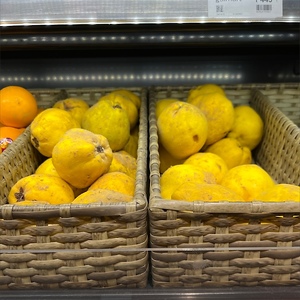
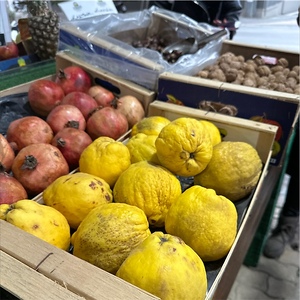
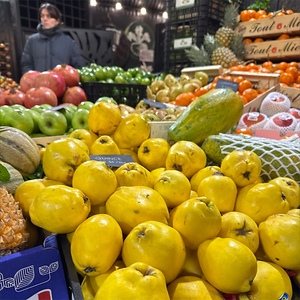
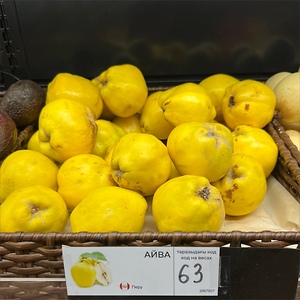
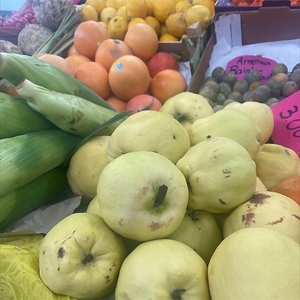
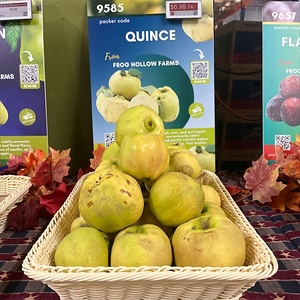
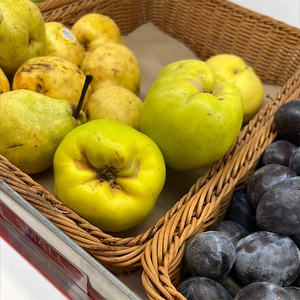
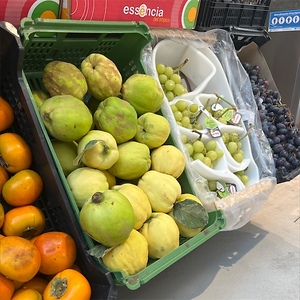
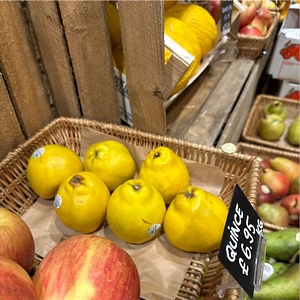
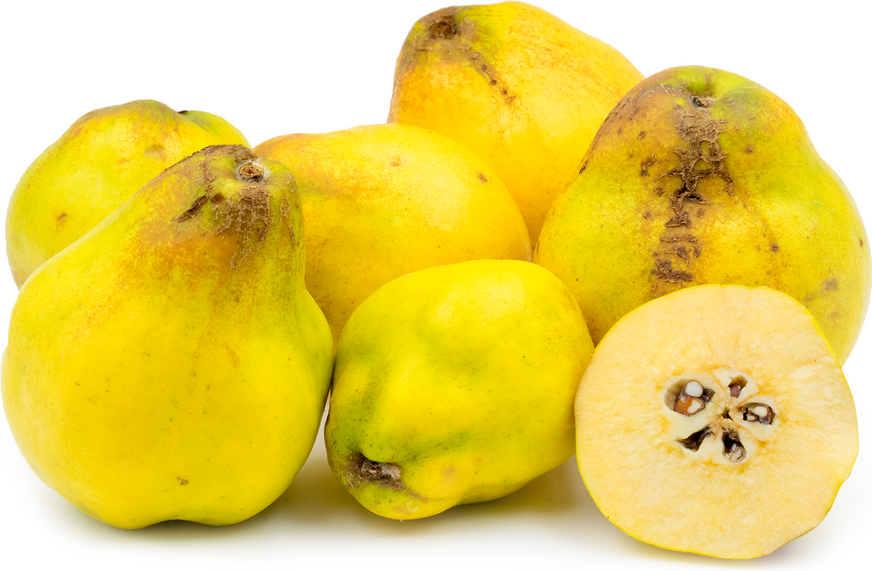
Quinces are a lumpy, pear-shaped fruit, measuring approximately 6 to 13 centimeters in height and 6 to 9 centimeters in width. These fruits have a bright yellow-green hue with faint lime-green streaks at the top. They may also feature tiny, barely visible dots with some darker brown cracking that should be cut around upon consumption. Quinces may be smooth or covered in a soft fuzz, an indication that the fruit is young and will rub off as it ripens. When cut in half width-wise, their flesh looks like that of an apple. This flesh has a light white-yellow hue and a hard, dry, and grainy texture similar to a pear. It turns pink and becomes tender and soft when cooked. Quinces have a strong floral, lush, and tropical scent with guava-like notes. When raw, these fruits taste astringent and sour, which is why they require cooking to be edible. Quinces turn into a rich candy-like paste when slowly cooked and become a deep apricot color with floral honeyed flavors.
Seasons/Availability
Quinces are available from late summer to fall.
Current Facts
Quinces are botanically classified as Cydonia oblonga and belong to the Rose family. They are the sole member of the Cydonia genus but come in many varieties, including Smyrna, Angers, Champion, Pineapple, and Orange Quinces. Quinces are closely related to pears and apples, which is evident from their similar appearance. The Greeks referred to this fruit as Melimelum, meaning honey apple due to their use in honey-preserved jams. The Portuguese called Quinces Marmelo, a variation of the Greek term, and enjoy their marmelado, a popular Quince confection. Quince trees once grew in abundance and were a symbol of love and fertility in Ancient Rome and Greece. They are now mainly found in the Middle East, Europe, Turkey, China, and Latin America where they are used for their culinary properties.
Nutritional Value
Quinces are a source of vitamin C, a nutrient essential for maintaining a healthy immune system, supporting skin health, and aiding in the absorption of iron from plant-based foods. They also contain copper, encouraging the formation of red blood cells, maintenance of healthy connective tissues, and production of energy. Quinces have been used medicinally for centuries. During the Middle Ages, these fruits were employed as a styptic, diuretic, and astringent. They were also used as a poultice and as a treatment for dysentery. The mucilage from Quince seeds possesses emollient and humectant properties that make them suitable for natural cosmetics.
Applications
Due to their tough, sour, and astringent nature, Quinces are primarily eaten cooked. Their high pectin content makes them ideal for jams, jellies, fruit leather, and candy. Quinces can be poached in wine with vanilla beans or cooked down with sugar until solidified to create membrillo, a type of paste traditionally paired with Spanish cheeses like Manchego. They can be combined with other fall fruits, such as apples or pears, reduced into compote, or added to spiced cake batters. Quinces also have savory uses, often added to beef and lamb stews or slow-cooked with roasts. They have a prominent role in confections across Moroccan, Persian, Romanian, and Balkan cuisines. To store Quinces longer, wrap each fruit individually in a double layer of plastic and refrigerate.
Ethnic/Cultural Info
In Greek mythology, Quinces were associated with love and fertility and were considered a divine offering to the gods. According to one myth, Eris, the goddess of strife, rolled Quinces into a wedding bouquet with the inscription "to the fairest" written on them. Goddesses Hera, Aphrodite, and Athena all claimed the bouquet as their own. They then competed to win both the bouquet and the title of "the fairest," with Paris, the most handsome of mortal men, serving as the judge. Despite Athena offering wisdom and Hera offering power, Paris chose Aphrodite because she offered him the love of Helen of Sparta, the most beautiful mortal woman. This decision had dire consequences as Helen was then taken away from her husband, King Menelaus of Sparta, eventually igniting the Trojan War.
Geography/History
Quinces are native to Western Asia and the Caucasus region of Southeastern Europe, with their origins believed to be in Iran and Turkestan. They were traded and cultivated throughout the Middle East and the Mediterranean for centuries and were once grown on trees throughout the city of Cydonia in Crete, which is modern-day Khania. Quinces were a kitchen staple in the United States due to their high pectin content, which was essential for making jellies. This remained true until the 19th century, when commercial gelatin and pectin were developed. They have now become a specialty item in most of North America but remain popular in many Latin American countries where they’re used as a cooked jelly called dulce de membrillo. Quinces continue to be widely farmed in Chile, Argentina, South Africa, Australia, Europe, Morocco, Iran, and Turkey. Outside of these areas, Quince trees may be planted from seed in gardens and orchards or the fruit may be found at farmers’ markets and grocery stores that specialize in international produce.
Recipe Ideas
Recipes that include Quince. One
 is easiest, three is harder.
Latest in season fruits and vegetables posted from the Specialty Produce App