







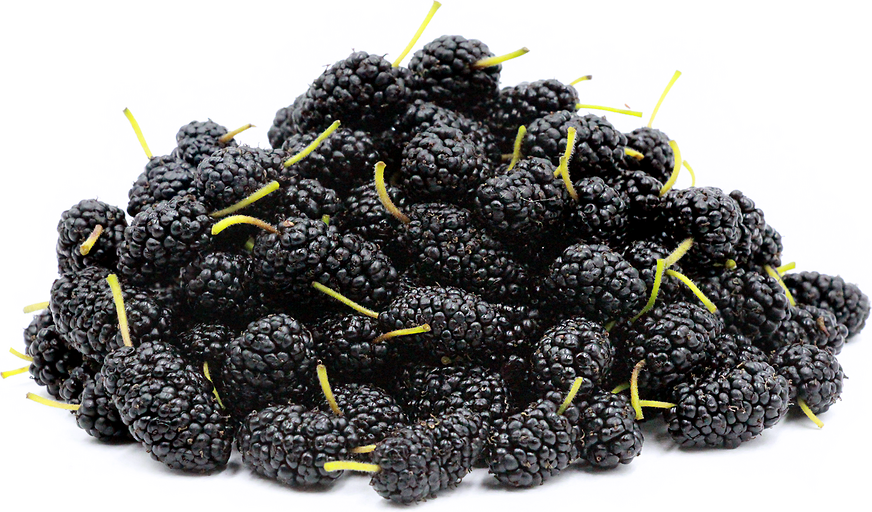


Mulberries
Inventory, 12 ct : 0
Description/Taste
Mulberries are not botanically classified as a berry, but rather an aggregate of many tiny fruit clusters arranged around a central stem. They are similar in appearance to an elongated blackberry, although they can ripen to a deep purple, black, red or white, depending on the variety. Mulberries have a good balance of sweet and tart flavors, sometimes with a hint of baking spices or woody cedar. The aromatic, deeply colored fruits are fragile and syrupy, and are known to stain at the slightest touch. The productive mulberry trees can reach anywhere from 30 to 80 feet tall, and some species can live and produce fruit for centuries.
Seasons/Availability
Mulberries are available mid-summer.
Current Facts
Mulberries belong to the Moraceae family, also called the mulberry or fig family, and they are in the genus, Morus, one of the most complex in the plant kingdom. So complex, in fact, that there’s no concrete consensus on the exact number of species of mulberries. Although there are at least 100 different species that have been documented, along with numerous hybrids, only 10 to 16 of those are accepted as true mulberry species among botanists. The three main species recognized for their economic importance are the Red or American mulberry, botanically called Morus rubra, the White mulberry, Morus Alba, and the Black mulberry, Morus nigra. Despite the fact that mulberry trees are extremely fruitful, with some yielding a couple hundred pounds of fruit per year, the fruit’s fragility and tendency to bruise and leak easily makes them not so commercially viable, and hence they are most often found at farmer’s markets or specialty grocery stores in regions where they are grown, including China, the Eastern Mediterranean, the Middle East, Northern Africa, and throughout the United States.
Nutritional Value
Mulberries contain good amounts of beta-carotene, iron, potassium, manganese, folic acid, and vitamins A, C, K, and B-complex. They are rich with antioxidants, including anthocyanin, which is responsible for the deep red or purple coloring in fruits and vegetables. Mulberries are also known for containing resveratrol, a plant compound that acts like an antioxidant in the body, and is being studied for its potential disease-fighting and anti-aging properties.
Applications
Mulberries are commonly used in ice cream, sorbet, jams, jellies, beverages, gastriques, and baked goods, especially pies. They can be substituted for blackberries, but are considerably sweeter and have a lower moisture content. Be sure to remove their inner stem, which may be fibrous, or thoroughly puree to avoid any unwanted fragments. Complimentary pairings include other bramble berries, stone fruit, young cheeses such as burrata and chevre, pork, duck, wild game, basil, mint, baking spices, and arugula, cream, mascarpone and citrus.
Ethnic/Cultural Info
There are several references to the Mulberry in the works of William Shakespeare. For instance, in the tragedy Coriolanus, he mentions the fragility and staining quality of ripe Mulberries, “now humble as the ripest mulberry that will not hold the handling”.
Geography/History
The earliest documentation of Mulberries traces them back to China. They became naturalized in Europe centuries ago with the westward expansion of the “Silk Road”. They were eventually introduced into America during early colonial times when General Oglethorpe imported 500 White mulberry trees to Fort Frederica in Georgia in 1733. He wanted to encourage silk production at the English colony of Georgia, but was unsuccessful. Today Mulberries still grow in China as well as throughout the Eastern Mediterranean, the Middle East, Northern Africa and within limited regions of the United States.
Recipe Ideas
Recipes that include Mulberries. One
 is easiest, three is harder.