



Malanga
Estimated Inventory, 10 lbs : 0
Description/Taste
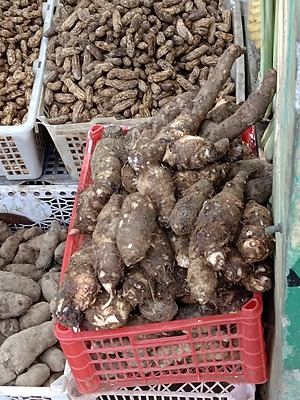
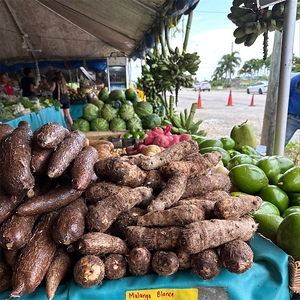
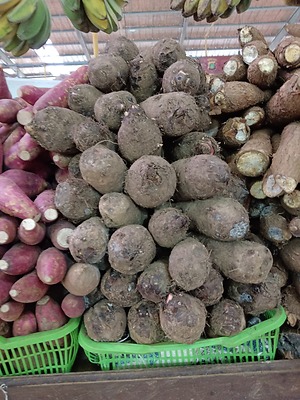
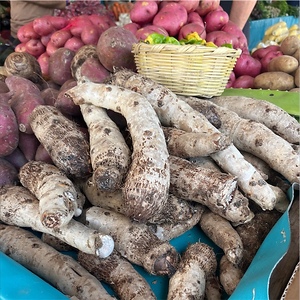
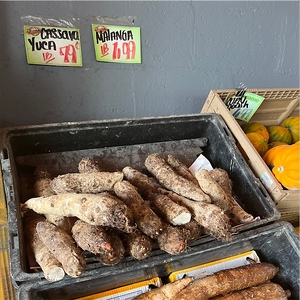
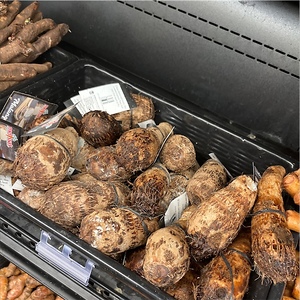
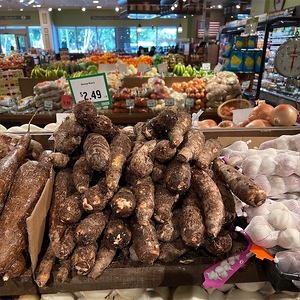
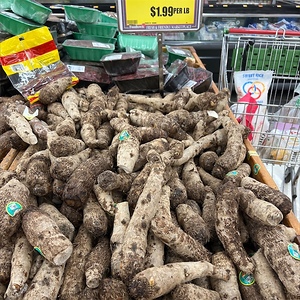
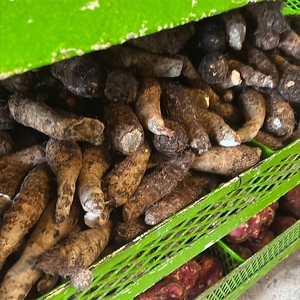
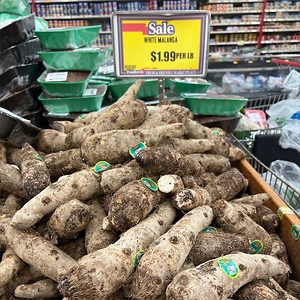
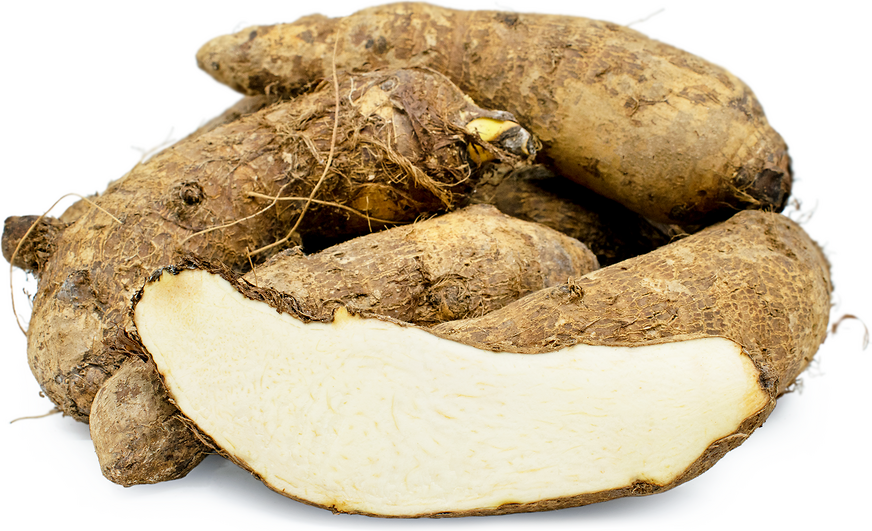
Malanga is comprised of a central underground corm that widely ranges in size and appearance, depending on the soil and growing conditions. The corms are generally oblong to cylindrical, tapering to blunt, curved edges, and they can often resemble the size, shape, and coloring of yams. The central corm is also surrounded by clusters of smaller corms known as cormels. These cormels share a similar appearance to the central corm but are typically smaller in size. The corm's skin is thin but tough, rough, and hard, found in variegated hues of gray-brown, brown, to light brown with patches of root hairs, scaling, nodes, and woody elements. Underneath the surface, the solid, dense flesh is white, yellow, to pale red, depending on the variety, and has a crisp, firm, and waxy consistency. When cooked, Malanga corms develop a soft and starchy texture similar to potatoes and yuca. Malanga corms are ready for harvest when their leaves turn brown and begin to fall over. It is important to note that Malanga cannot be consumed raw due to its calcium oxalate content. These crystals are eliminated from the flesh when the roots are cooked, and the corms are viewed as a neutral, filling ingredient, readily absorbing accompanying flavors. Malanga has a mild, earthy, and nutty taste. Attached to the corm above ground are large, arrow-shaped, tapered green leaves connected to upright stalks reaching over two meters in height. The leaves are edible when young and have a fresh, green, and herbal flavor.
Seasons/Availability
Malanga is available year-round.
Current Facts
Malanga, botanically classified as Xanthosoma sagittifolium, is a tropical to subtropical species belonging to the Araceae family. The fast-growing herbaceous plant is native to the Americas and has been spread worldwide as an ornamental and culinary species. Malanga is traditionally grown for its underground corm, harvested 10 to 12 months after planting. There are several varieties of Malanga, and many of these plants are challenging to differentiate, leading botanists to generally label them under one common species name. Malanga is also known by regional names, including Yautia, Tannia, Taniera, or Chou Caribe in the Antilles, Tiquisque in Costa Rica, Malangay in Colombia, Queiquexque in Mexico, Mangreto, Taioba, Mangaras, and Mangarito in Brazil, Macal in the Yucatan, Gualuza in Bolivia, Quiscamote in Honduras, Okumo in Venezuela, Uncucha in Peru, New Cocoyam, and Yautira. Despite their widespread use as a filling culinary ingredient with extended storage capabilities, Malanga corms are not commercially produced on a large scale and are cultivated on a small-scale through select growers worldwide. Malanga corms must be cooked to remove harmful compounds, and once prepared, they contribute a dense texture and mild, earthy, and nutty flavor to recipes. They are also used as a thickening ingredient and are cooked in a wide variety of sweet and savory preparations, treated similarly to a potato or yam.
Nutritional Value
Malanga is a source of potassium to balance fluid levels within the body, phosphorus to repair cellular tissues, and fiber to regulate the digestive tract. The corms also provide magnesium to support optimal nerve functioning, calcium to build strong bones and teeth, iron to develop the protein hemoglobin for oxygen transport through the bloodstream, and other nutrients, including vitamin B6, folate, beta-carotene, and vitamin A. Raw Malanga contains oxalic acid. This naturally occurring compound can bind to minerals, preventing their absorption and causing problems in the digestive tract. Oxalic acid is toxic in large quantities, but its damaging nature dissipates when the corms are cooked.
Applications
Malanga cannot be consumed raw and must be cooked to remove oxalic acid from the flesh. The corms should be scrubbed under running water, and the hairy skins removed before cooking. After the flesh is peeled, it should be rinsed in and covered in cold water. In many countries, Malanga is peeled and boiled, or it can be cooked and mashed with butter and cream as a side dish. Mashed Malanga is often paired with steak and onions as a main dish, and complements salty, dried meats, fish, or spicy sausage. The corms can also be sliced and fried into chips, pureed into sauces and creams, grilled as a side, or sliced into pieces and roasted like a French fry. Try grating Malanga with flour, egg, and herbs into patties and cooking them to make fritters or stuff the cooked corm into empanadas. Malanga corms can be used similarly to potatoes, yams, and other root vegetables, and as long as they are cooked, they can be used as a substitute for roots or tubers in most recipes. Beyond using the corms whole or in pieces, Malanga can be ground into flour and utilized as a natural thickener for soups and stews. The flour can also be mixed into baked goods such as bread and cakes or added to puddings. The plant's young leaves are a secondary culinary crop and can be cooked similarly to spinach. The leaves can be added to soups and stews, used as a bed of sauteed greens, or mixed into callaloo, a Caribbean dish comprised of chile peppers, greens, tomatoes, and aromatics. Malanga pairs well with spices such as ginger, cinnamon, smoked paprika, and thyme, aromatics including garlic, onion, shallots, and chile peppers, coconut milk, grains, and dark leafy greens. Whole, unwashed Malanga can be stored for 1 to 2 weeks at room temperature or for 2 to 3 weeks in the refrigerator. Peeled, raw corms can be stored for 1 to 2 days before cooking, and once cooked, the corms should be consumed within one week when kept in the refrigerator.
Ethnic/Cultural Info
Xanthosoma species are widely grown as an ornamental in South America, favored for their large, wide-spreading leaves. Each smooth and waxy leaf can grow up to one meter in length and has a distinct cordate to arrowhead-like shape with a tapered, pointed end. Among botanists, the tropical, perennial plants are sometimes categorized under a general plant grouping known as Elephant Ears. There are three main genera belonging to the Araceae family that are encompassed under the Elephant Ears name, including Xanthosoma, Alocasia, and Colocasia. While the three genera are distinct in their own ways, the plants received this descriptor for their leaf's similarity in shape to an elephant's ear. Elephant Ear plants are favored by landscape designers for their dramatic nature and are valued more for their leaves than their flowers. The leaves provide added coloring, textures, and shapes to home gardens.
Geography/History
Malanga is native to tropical and subtropical lowland regions of South America and has been growing wild since ancient times. The plants were first domesticated in the northern areas of South America as a cultivated food crop, and they were later spread into Mesoamerica and the Antilles by migrating indigenous groups. Malanga thrived in humid environments and was eventually introduced into the Caribbean, where it quickly naturalized. When Spanish explorers arrived in the Caribbean, they encountered Malanga and brought the edible corms on expeditions to West and Central Africa sometime before the mid-1800s. After its introduction into Africa, Malanga was extensively planted as a famine crop for its edible corms and continued to expand as a staple crop worldwide. Despite its useful nature, Malanga has never been commercially produced globally and is primarily localized to its growing regions. Many small-scale growers also struggle to sell the species in markets as younger consumers are not used to cooking the corms, leading the species to be at risk of being abandoned by future generations. Today Malanga is grown in Central America, the Antilles, and the Caribbean, especially in Puerto Rico and Cuba. The variety is also grown in New Zealand, Africa, parts of Southeast Asia, the Pacific Islands, South America, Mexico, and in Florida of the United States. The corms are available in most specialty food markets or farmer’s markets in the tropical and sub-tropical areas where it is grown.
Recipe Ideas
Recipes that include Malanga. One
 is easiest, three is harder.
| cook2eatwell |
|
FRITURAS DE MALANGA (MALANGA FRITTERS) |
| Latina Mom Meals |
|
Puerto Rican Beef Stew |
| Paleo Porn |
|
Paleo Malanga Latkes |
| The Spruce Eats |
|
Traditional Puerto Rican Pasteles |

Latest in season fruits and vegetables posted from the Specialty Produce App