


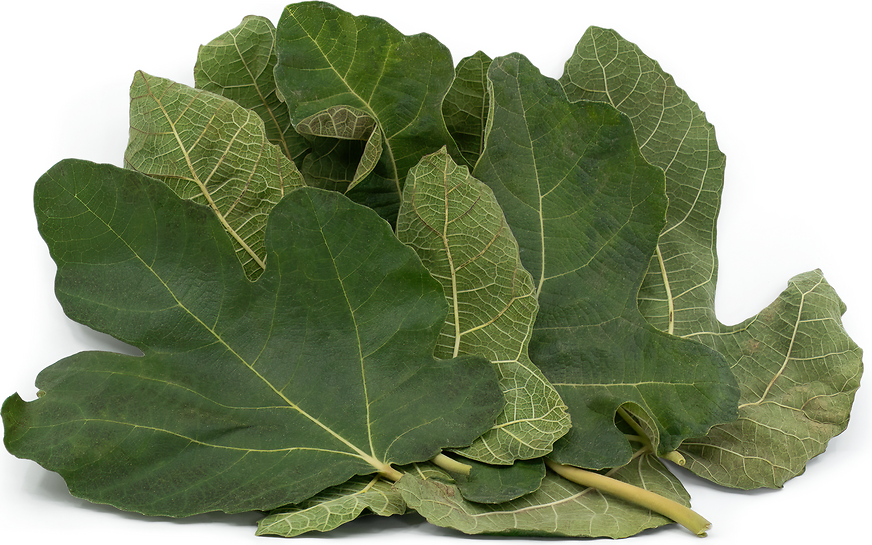


Fig Leaves
Estimated Inventory, ea : 0
Description/Taste
Fig leaves are large, broad, and flat, averaging 12-25 centimeters in length and 10-18 centimeters in width. The bright, vibrant green leaf has 3-5 lobes with thick veins and a prominent stem. They grow in an alternate pattern, and the top of the leaf is rough and sandpaper-like, while the bottom of the leaf has small, stiff hairs. The edge of the leaf has serrated edges that point slightly forward, and Fig leaves change to a yellow hue in the fall. Fig leaves are highly fragrant and crushing the leaves will release scents of coconut, peat, vanilla, and green walnut.
Seasons/Availability
Fig leaves are available during the summer.
Current Facts
Fig leaves, botanically classified as Ficus carica, grow on a deciduous tree or shrub and are members of the Moraceae, or mulberry family. Known for its fleshy fruits, fig trees thrive in warm and dry climates and can grow to be 3-9 meters in height. The fig was believed to be one of the earliest cultivated fruits, and the leaves have also been used since ancient times medicinally and as a symbol of modesty in art.
Nutritional Value
Fig leaves are a good source of vitamin A, B1, and B2. They also contain calcium, iron, phosphorus, manganese, sodium, and potassium.
Applications
Fig leaves are best suited for cooked applications such as steaming, baking, or grilling. They are commonly used as a wrap and are steamed with meats, seafood, and vegetables to impart a smoky, fruity flavor and a distinct coconut aroma. In addition, Fig leaves can be used to make a syrup for glazing meats, to flavor cocktails, to create a jelly, baked goods, and blended Fig leaves can be steeped in a cream base to create ice cream. Dried Fig leaves can also be boiled and used for making tea. Fig leaves pair well with cream, coconut milk, scallions, rice, fish sauce, apricots, red chile peppers, basil, red curry paste, pepitas, tofu, chicken, and fish. Fig leaves are highly perishable and will keep 1-2 days when stored fresh in the refrigerator.
Ethnic/Cultural Info
Fig trees have come to symbolize knowledge, enlightenment, passion, and fertility in various cultures. In Greek mythology, Dionysus, the god of agriculture, wine, fertility, and ritual madness, introduced mankind to the fig tree. His name translates to 'friend of the fig' and during festivals to honor Dionysus, nuns would wear garlands made of Fig leaves on their heads. In addition to Greek mythology, the Greeks consumed figs as a part of their daily diet, and both the fruit and leaves appear in their art and architecture.
Geography/History
Fig trees are believed to have originated in the Middle East in villages near ancient Jericho and can be traced back over 11,400 years ago. They were then spread to Egypt, China, India, and the Mediterranean. Today fig trees are widely cultivated, and the leaves can be found in specialty markets in Europe, Asia, North and South America, Africa, and Australia.
Recipe Ideas
Recipes that include Fig Leaves. One
 is easiest, three is harder.