



Armenian Cucumber
Estimated Inventory, 18 lbs : 0
Description/Taste
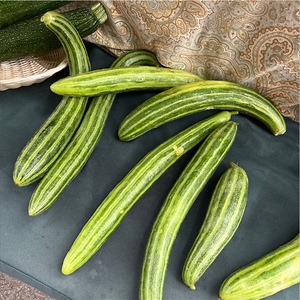
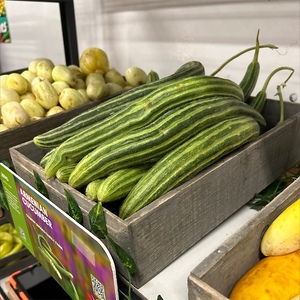
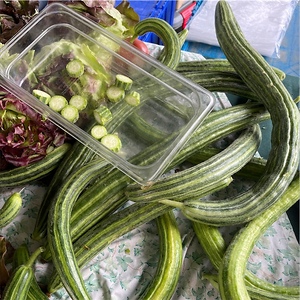
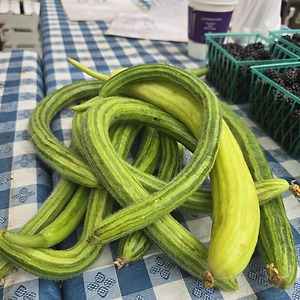
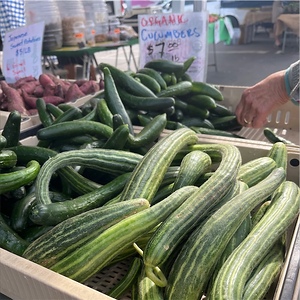
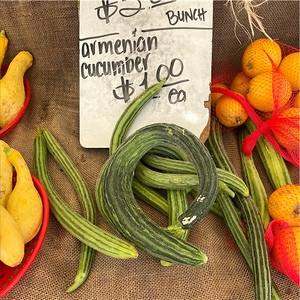
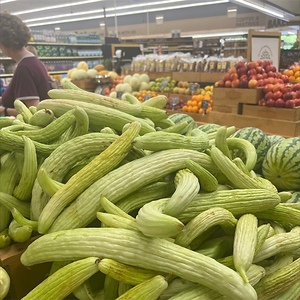
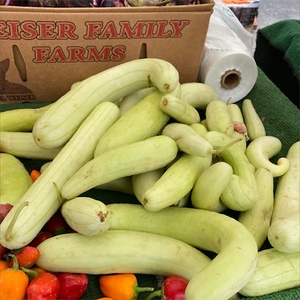
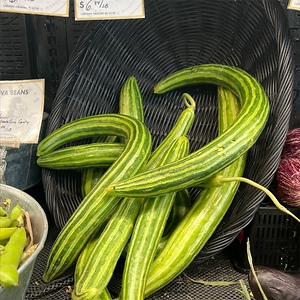
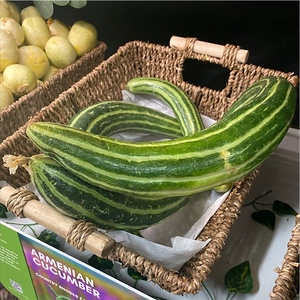
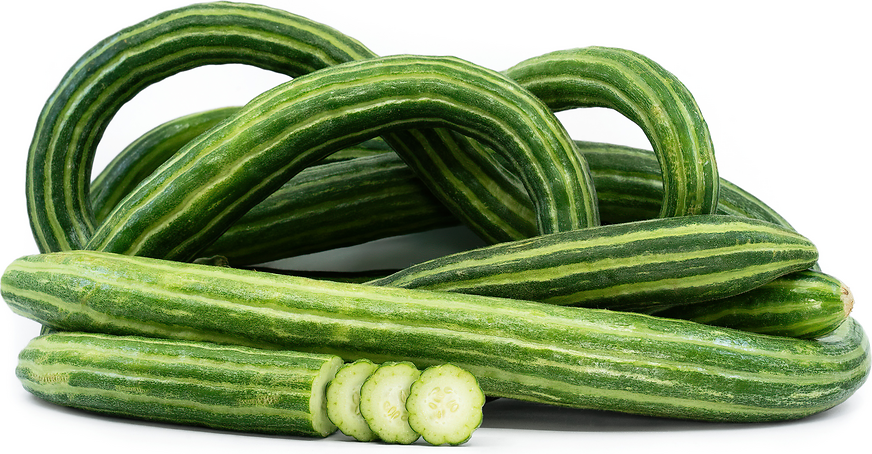
Armenian cucumbers are slender, elongated vegetables that grow on vines. They have a cylindrical, curved shape that's often irregularly curled, measuring about 25-38 centimeters long. This variety has thin skin that ranges from dark to light green and is sometimes striped. Their skin is smooth with a somewhat fuzzy texture especially when the vegetable is young. Their ribbed surface is due to the longitudinal furrows that cover their surface. Armenian cucumbers have a light green flesh that’s crunchy, succulent, and crisp, encasing multiple teardrop-shaped, edible white seeds that take up a significant portion of the vegetable's center. When sliced, Armenian cucumbers give off a scent reminiscent of cantaloupe. They have a sweet and mild taste, similar to other varieties of cucumber.
Seasons/Availability
Armenian cucumbers are available from late spring to summer.
Current Facts
Armenian cucumbers are botanically classified as Cucumis melo and belong to the Cucurbitaceae family. This variety is also called Yard-long melon, Snake melon, Snake cucumber, Uri, Gutah, and Painted Serpent. Despite their name, they are technically classified as melons rather than cucumbers and are closely related to cantaloupe. There are several different cultivars that range in size, flavor, and color. These include the Striped Armenian, Carosello Barese, Mandurian Round Carosello, and Metki Dark Green. Armenian Cucumbers are often cultivated on trellises, tunnels, and twine because of their vertical growth patterns. Their vines can extend up to 6 meters or more, with the potential for even greater length in warmer climates.
Nutritional Value
Armenian cucumbers are a good source of vitamins C, A, and K. These vitamins help with immunity, vision, iron absorption, collagen production, heart, lung, and kidney function, bone health, and blood clotting. They provide the body with potassium, a nutrient that may help reduce blood pressure and regulate fluid balance, muscle contractions, and nerve signaling. Armenian cucumbers have fiber for improving digestion and promoting fullness after eating. This variety has little to no sugar, making them a good choice for diabetics managing their blood sugar levels.
Applications
Armenian cucumbers can be used in both raw and cooked applications. They may be sliced lengthwise, widthwise, diced, or julienned as well as grilled, puréed, or pickled. The variety's thin skin makes them an ideal fresh slicing cucumber that does not need to be peeled. Armenian cucumbers are popularly paired with leafy greens and pasta salads. Their delicate flavor makes them a welcomed textural component in sandwiches and sushi. Complimentary ingredients include red and white fish, shellfish, chilies, tomatoes, mint, oregano, yogurt, garlic, cumin, chicken, pork, and fresh cheeses such as feta and chevre. Whole Armenian cucumbers will keep for up to a week in the refrigerator. Once cut, they should be wrapped in plastic to extend their shelf life.
Ethnic/Cultural Info
In a period of massacre and genocide during the Ottoman Empire of the mid-1890s, many surviving Armenians immigrated from their homeland to Central California. With them they brought Armenian cucumbers, which they referred to as goorah or kitah. This vegetable eventually made its way to Tuscon, Arizona, where an Armenian woman made newspaper headlines for growing a nearly meter-long cucumber. For these immigrants, the Armenian cucumber represents both migration and heritage. This deep connection is reflected in traditional dishes such as Jajik, a generations-old Armenian recipe that features this distinctive vegetable. Jajik is made with cucumbers, yogurt, garlic, and mint and is often consumed in the summer to combat hot temperatures. It's typically served with pita chips or flatbread and pairs well with chicken and rice.
Geography/History
Armenian cucumbers were first bred in Armenia during the 15th century, having first originated in the tropics and subtropics of Asia. They are a cultivated variety that grows best in warm, sunny climates and is favored by both commercial producers and home gardeners. Armenian cucumbers were introduced to Europe in the 1400s when they were brought to Italy, where they were named Melono after a city near Rome. They were brought to the United States when Armenians fleeing the Hamidian massacres migrated there during the late 1800s and early 1900s. Once there, many of these immigrants started farming for a living, selling produce like Armenian cucumbers as well as fruits, nuts, and raisins, exposing consumers to this vegetable for the first time. Today, this variety is commonly sold throughout the Mediterranean, Japan, Turkey, India, and Lebanon. These cucumbers can be found growing in California and may be available at specialty grocers and farmers' markets in the United States and Europe.
Recipe Ideas
Recipes that include Armenian Cucumber. One
 is easiest, three is harder.
| The Kitchn |
|
Armenian Cucumber Salad |
| Kale Junkie By Nicole K. Modie |
|
10-Minute Armenian Cucumber & Tomato Salad |

Latest in season fruits and vegetables posted from the Specialty Produce App